From TUESDAY, JUNE 11, 2013
Here's a question about evolutionary psychology. Not a rhetorical question or a snarky question (even though I have been a bit snarky on the subject in the past). Everyone knows why we evolved to seek out salt, sugar and fat in our diet, but why did we evolve to favor an extremely rugged yet malleable culinary landscape?
Take breakfast, for example. Sometimes (though not often) I'll hit a diner and say what-the-hell and get coffee, juice, eggs, bacon, hash browns, and biscuits. With the exception of the juice and the bacon (which are already optimized), I will add the right level of flavorings to each dish to get it to its landscape maxima (sugar for the coffee, salt and pepper for the eggs, hot sauce and ketchup for the hash browns, jam or maybe even sausage gravy for the biscuits).
The optimization is done on a dish-by-dish basis and is, for the most part, independent. If only eggs are available, I'll have a sugar-free breakfast. If all I have around the house is coffee and fruit, I'll have a low-sodium breakfast. Though there's an evolutionary imperative that makes me crave sugar and salt, it is somehow dependent on the other coordinates of the landscape. I want sugar but not salt with my coffee, salt but not sugar with my eggs and both salt and (caramelized) sugar in my hot chocolate.
Small children complain loudly and adults mumble grumpily when certain foods mix on a plate even though, as parents often remind us, it all goes to the same place.
How did our places get so context-sensitive?
Thursday, July 2, 2015

Tuesday, June 30, 2015
"Grow it yourself Plan a farm garden now."
From Wikipedia:

Title: Grow it yourself Plan a farm garden now.
Creator(s): Bayer, Herbert, 1900-1985, artist
Related Names:
United States. Rural Electrification Administration , sponsor
Date Created/Published: NYC : NYC WPA War Services, [between 1941 and 1943]
Medium: 1 print (poster) : silkscreen, color.
Summary: Poster for the U.S. Department of Agriculture promoting victory gardens, showing carrots, lettuce, corn, tomatoes, and potatoes growing.
Victory gardens, also called war gardens or food gardens for defense, were vegetable, fruit, and herb gardens planted at private residences and public parks in the United States, United Kingdom, Canada, Australia and Germany during World War I and World War II. They were used along with Rationing Stamps and Cards to reduce pressure on the public food supply. Besides indirectly aiding the war effort, these gardens were also considered a civil "morale booster" in that gardeners could feel empowered by their contribution of labor and rewarded by the produce grown. This made victory gardens a part of daily life on the home front.

Title: Grow it yourself Plan a farm garden now.
Creator(s): Bayer, Herbert, 1900-1985, artist
Related Names:
United States. Rural Electrification Administration , sponsor
Date Created/Published: NYC : NYC WPA War Services, [between 1941 and 1943]
Medium: 1 print (poster) : silkscreen, color.
Summary: Poster for the U.S. Department of Agriculture promoting victory gardens, showing carrots, lettuce, corn, tomatoes, and potatoes growing.
"The Children Must Learn"
Fascinating little covering circa 1940 views of nutrition, education and rural poverty.
Two of the comments were worth noting
Fans of classic films like the Hustler may also recognize the voice of the narrator, Myron McCormick.
Children Must Learn, The
by Educational Film Institute of New York University and Documentary Film Productions, Inc.
Published 1940
Usage Public Domain
Topics Education, Appalachia, Rural America
Educating the children of Appalachia.
Director: Willard Van Dyke.
Script: Spencer Pollard.
Photography: Bob Churchill.
Narration: Myron McCormick.
Editor: Irving Lerner.
Music: Fred Stewart.
Run time 12:34
Producer Educational Film Institute of New York University and Documentary Film Productions, Inc.
Sponsor Sloan (Alfred P.) Foundation
Two of the comments were worth noting
Reviewer: roncox - - September 8, 2011
Subject: My sister and her family
This film is of my sister Nellie and her family. Mr. and Mrs. Marion Lynch with their children, Norma Doris, Winnona and Harold D.. The couple on the porch is Marion's parents Dudley P. and Mary Lynch. This is the Lynchtown School at Drip Rock KY.
Reviewer: juanita lynch - - September 5, 2011
Subject: My Family
Despite the economic hardships of the era in which they lived, my parents, Marion and Nellie Lynch were hard working, honest people who always had a sense of dignity and pride which they passed on to all their children. This documentary is very special and I am so thankful to have them as my parents. Thank you to all who have made this possible.
Fans of classic films like the Hustler may also recognize the voice of the narrator, Myron McCormick.
Children Must Learn, The
by Educational Film Institute of New York University and Documentary Film Productions, Inc.
Published 1940
Usage Public Domain
Topics Education, Appalachia, Rural America
Educating the children of Appalachia.
Director: Willard Van Dyke.
Script: Spencer Pollard.
Photography: Bob Churchill.
Narration: Myron McCormick.
Editor: Irving Lerner.
Music: Fred Stewart.
Run time 12:34
Producer Educational Film Institute of New York University and Documentary Film Productions, Inc.
Sponsor Sloan (Alfred P.) Foundation
Monday, June 29, 2015
Wow, I had no idea Grape-Nuts could do that
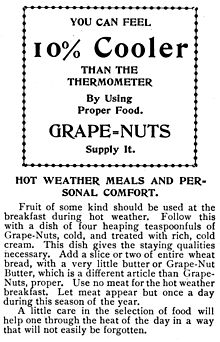
1900 was kind of the golden age for ludicrous food claims, but we are trying to catch up.
Saturday, June 27, 2015
American Agriculture Movement pins from the Smithsonian
I tend to be distrustful of protest movements. They make a lot of noise, but when the dust settles, the results are mainly cathartic, and I have remarkably little interest in other people's catharsis.

American Agriculture Political Pin
MEASUREMENTS:
overall: 3 in; 7.62 cm
OBJECT NAME:
button
SUBJECT:
Agriculture
CREDIT LINE:
Gift of Clifford Hamilton
ID NUMBER:
1993.0188.010
ACCESSION NUMBER:
1993.0188
CATALOG NUMBER:
1993.0188.010
DESCRIPTION:
The American Agriculture Movement was started in the fall of 1977 in response to the 1977 Farm Bill which had the adverse affect of dropping commodity prices to a level lower than the cost of production. President Jimmy Carter’s agricultural policies were considered detrimental to the American farmer by many members of the American Agriculture Movement. Here newscaster David Brinkley is seen pulling President Carter’s strings as if President Carter was his puppet. President Carter, as well as his cabinet officers, were often vilified for their ineffective policies.


The American Agriculture Movement was started in the fall of 1977 in response to the 1977 Farm Bill which had the adverse affect of dropping commodity prices to a level lower than the cost of production. In February of 1979, members of the American Agriculture Movement organized a tractorcade, a protest on tractors, in Washington, D.C. Farmers from around the country, some driving from more than 1500 miles away, arrived by the thousands. On February 5, they convened in Washington, D.C. from four different directions. In order to accommodate both the protesters and the city’s residents, the D.C. police required them to park on the National Mall and restricted their protests to specific times during the day.
American Agriculture Political Pin
MEASUREMENTS:
overall: 3 in; 7.62 cm
OBJECT NAME:
button
SUBJECT:
Agriculture
CREDIT LINE:
Gift of Clifford Hamilton
ID NUMBER:
1993.0188.010
ACCESSION NUMBER:
1993.0188
CATALOG NUMBER:
1993.0188.010
DESCRIPTION:
The American Agriculture Movement was started in the fall of 1977 in response to the 1977 Farm Bill which had the adverse affect of dropping commodity prices to a level lower than the cost of production. President Jimmy Carter’s agricultural policies were considered detrimental to the American farmer by many members of the American Agriculture Movement. Here newscaster David Brinkley is seen pulling President Carter’s strings as if President Carter was his puppet. President Carter, as well as his cabinet officers, were often vilified for their ineffective policies.
The American Agriculture Movement was started in the fall of 1977 in response to the 1977 Farm Bill which had the adverse affect of dropping commodity prices to a level lower than the cost of production. In February of 1979, members of the American Agriculture Movement organized a tractorcade, a protest on tractors, in Washington, D.C. Farmers from around the country, some driving from more than 1500 miles away, arrived by the thousands. On February 5, they convened in Washington, D.C. from four different directions. In order to accommodate both the protesters and the city’s residents, the D.C. police required them to park on the National Mall and restricted their protests to specific times during the day.
Friday, June 26, 2015
Not exactly a food ad, but still too tacky to be forgotten
Virginia Slims (from the good people at Phillip Morris)
In the 1960s and 1970s, the themes of feminism and women's liberation, with the slogan "You've Come A Long Way, Baby" were often used in the ads, and often featured anecdotes about women in the early 20th century who were punished for being caught smoking, usually by their husbands or other men, as compared to the time of the ads when more women had equal rights, usually comparing smoking to things like the right to vote
Thursday, June 25, 2015
Captain Tootsie -- a spokeshero goes mainstream
In the Golden Age of Comics, regular readers saw a lot of Captain Tootsie


The character was popular enough to have his own comic book for a couple of issues. Surprisingly, there was no mention of Tootsie Rolls in either the stories or the ads.


Captain Tootsie is an advertisement comic strip created for Tootsie Rolls in 1943 by C C Beck, Peter Costanza and Bill Schreider (1950 onwards). It featured the title character Captain Tootsie and his sidekick, a boy named Rollo, and two other young cohorts named Fatso and Fisty. It had stories in the form of full color one-page Sunday strips, black and white daily strips, and two issues of a comic book of the same title released by Toby Press. The advertisement comic was featured by many publishers and in the newspapers.For fans of the medium. The name C.C. Beck should ring a bell. He co-created Captain Marvel, arguably the most popular comic book character of the era.


The character was popular enough to have his own comic book for a couple of issues. Surprisingly, there was no mention of Tootsie Rolls in either the stories or the ads.


Subscribe to:
Posts (Atom)